
Stabilizer Topping (Wash-Away)
A clear film laid on top of the fabric before stitching to keep thread from sinking into the nap or pile.
As an Amazon Associate and affiliate partner, we may earn a small commission from qualifying purchases at no extra cost to you.
If you’ve ever stitched onto a towel, a fleece jacket, or a piece of velvet and watched the design sink into the fabric until it barely shows, you’ve run into the exact problem that soluble stabilizer embroidery topping is built to solve. Topping — also called water soluble topping, wash away topping, or embroidery topping film is a thin sheet of dissolvable film placed on top of the fabric, directly under the needle, before you start stitching.
Its only job is to create a smooth, flat surface over high-pile, looped, or textured materials so the stitches sit cleanly on top of the fibers instead of disappearing into them. Once stitching is complete, the excess film is torn away and any remaining bits are rinsed off, leaving nothing behind but a crisp, clean design.
Topping Goes On Top — Not Underneath
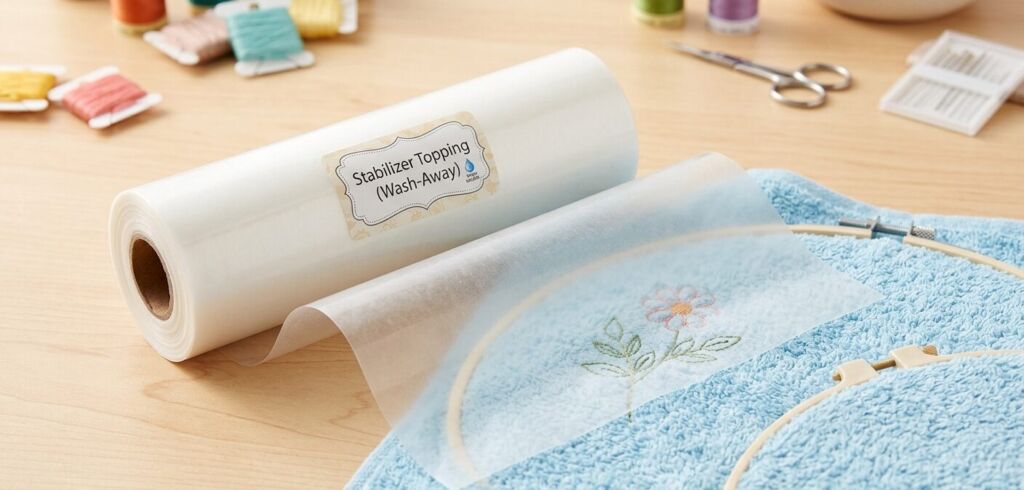
It’s easy to confuse topping with a backing stabilizer because both products get lumped together under the word “stabilizer” you may even see topping listed as embroidery stabilizer topping or embroidery topper stabilizer. The key difference is placement. A backing stabilizer is hooped underneath the fabric, against the back, to support the stitches structurally. Topping does the opposite: it’s laid on top of the fabric, facing the needle, and is never hooped beneath it.
Topping is also an addition, not a replacement. Whatever backing your project calls for a tear-away stabilizer, a cut-away stabilizer, a no-show mesh stabilizer, an adhesive sticky-back stabilizer, or even a wash-away stabilizer for freestanding lace — topping is layered on top of that backing, not used in place of it.
When Do You Need Topping?
Not every fabric needs a topping layer. It becomes essential whenever the surface has a pile, loop, or texture that stitches can sink into.
Fabrics that almost always need topping:
- Terry cloth towels
- Velvet
- Fleece
- Minky
- Faux fur
- Waffle weave
- Piqué polo shirts
The 3 Types of Embroidery Topping Film
Ultra-Lightweight Clear Film (25–35 Micron)
This is the thinnest topping you’ll use, and it’s usually the first one embroiderers reach for. Often searched for as clear embroidery stabilizer, this lightweight film is ideal for terry cloth towels, piqué polo shirts, and other low-to-medium pile fabrics where you simply need to tame the loops enough for clean stitch definition. Sulky Solvy (sometimes searched as solvy embroidery topping or solvy topping) and New brothread Topping Film are two of the most widely used options in this category.
Medium-Weight / Heavy Topping Film
When the pile gets thicker — think fleece, velvet, minky, or faux fur — a lightweight film won’t hold the fibers down enough and stitches will still get swallowed. A heavier topping film, sometimes labeled solvy water soluble topping, has more body and does a better job flattening deep nap before the needle reaches it. Sulky Ultra Solvy and Kimberbell Embroidery Topping are popular choices in this weight class.
Self-Adhesive / Sticky Topping
Some projects can’t be hooped at all, or the fabric shifts so much under the presser foot that a loose sheet of topping won’t stay put. For those situations, self-adhesive topping has a light tacky coating on one side that holds it in place on the fabric surface throughout stitching. Floriani Water Soluble Topping is a well-known example, and it’s especially useful for single-layer hooping, free-motion work, or oddly shaped items that resist a traditional hoop.
Topping Film Comparison Chart
| Topping Type | Best Used For | Micron Weight | Popular Brands |
|---|---|---|---|
| Ultra-Lightweight Clear Film | Towels, terry cloth, piqué polo shirts | 25–35 micron | Sulky Solvy, New brothread Topping Film |
| Medium / Heavy Topping Film | Fleece, velvet, minky, faux fur | 50–80 micron | Sulky Ultra Solvy, Kimberbell Embroidery Topping |
| Self-Adhesive / Sticky Topping | Hard-to-hoop or shifting fabrics | Varies (adhesive-backed film) | Floriani Water Soluble Topping |
Quick Answers
Do you put topping on top or underneath the fabric?
Topping always goes on top of the fabric, facing the machine’s needle — never underneath or behind it. This is the opposite of a backing stabilizer, which is hooped against the back of the fabric to support the stitches from below. Topping’s only job is to keep the fabric’s surface flat so stitches don’t sink into loops, pile, or texture, while the backing stabilizer underneath does the structural work.
How do you remove water-soluble topping after embroidery?
Once stitching is finished, gently tear away as much of the excess topping film as you can by hand. It should pull off in larger pieces, leaving only small bits trapped within the stitches themselves. Any remaining film dissolves completely when the item is rinsed under warm water or run through a gentle wash cycle, so don’t worry about removing every fragment by hand. Let the piece air dry, and the design will be clean and crisp with no stiff or scratchy film left behind.
Common Mistakes
Trying to use topping as a backing. ToOne of the most common mistakes is tearing off the topping immediately after stitching and skipping the rinse step entirely, which leaves tiny dissolvable fragments trapped in the stitches that dry into a stiff, scratchy residue against the skin. Another frequent error is reaching for clear packing tape or sticky tape as a quick substitute for proper topping film — tape doesn't dissolve, leaves adhesive residue on the needle and fabric, and can gum up the machine. Some embroiderers also try using a tear-away backing stabilizer as topping by placing it on top of the fabric instead of underneath; tear-away material doesn't dissolve in water and is designed to be ripped away from the back, so using it on top just traps stiff, paper-like debris inside the design. Always use a purpose-made water-soluble topping film on top of the fabric, paired with the correct backing stabilizer underneath, and finish with a rinse to dissolve any leftover residue.pping tears away easily and provides zero structural support for the garment itself. It must always be combined with a proper cut-away or tear-away base stabilizer underneath.
Frequently Asked Questions
Do I need topping if I'm embroidering on towels?
What topping should I use for velvet?
How do you get water-soluble topping off after stitching?
Does topping replace the need for a backing stabilizer?
Can I reuse leftover scraps of topping film?
As an Amazon Associate and affiliate partner, we may earn a small commission from qualifying purchases at no extra cost to you.
Digitizer's Insight
Even the right stabilizer cannot fix a poorly digitized file. If you're still experiencing puckering, gaps, or registration issues after using the correct backing, the root cause is almost certainly your DST/EMB file — not your setup. Our team at EZ Stitch Digitizing specialises in precision pull-compensation and density correction.
Get Professional Digitizing →