Choosing the standard embroidery needle isn’t just a minor setup step—it is the single most critical factor dictating stitch tension, thread shredding, and design sharpness. Whether you are running a single-needle Brother home machine or managing a multi-head commercial Tajima floor, using the wrong needle size or shank type leads to skipped stitches, broken threads, and damaged fabric.
This comprehensive guide breaks down standard embroidery needle sizes, needle point types, brand compatibilities (Schmetz, Organ, Groz-Beckert), and how to pair your needle with the proper stabilizer for flawless stitching every time.
Interactive Embroidery Needle & Stabilizer Selector
Use this interactive tool to instantly match your machine type, fabric, and thread weight with the exact needle size, point type, and backing required for your project.
Needle & Stabilizer Selector
Select your machine, fabric, and thread to get the exact needle size, point type, and backing for your project.
Understanding Needle Systems: Flat Shank vs. Round Shank
Before selecting a size, you must identify your machine’s mechanical shank system. Installing the wrong shank system can break your needle bar or damage your rotary hook.
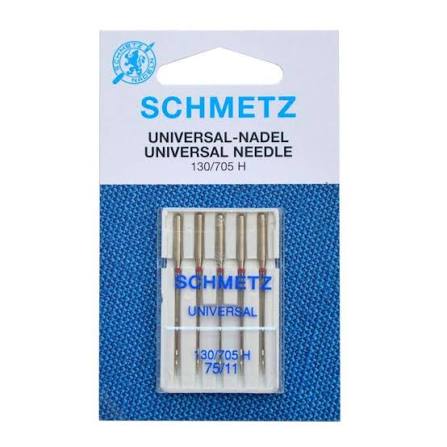
Home Embroidery & Sewing Machines (130/705 H-E System): Home machines from Brother, Janome, Singer, Baby Lock, and Bernina use flat-sided shank needles. The flat side faces toward the back of the machine when inserted.
Commercial & Industrial Machines (DBxK5 / DB-K5 System): Commercial multi-needle machines (Tajima, Barudan, Ricoma, Brother PR series, ZSK) utilize completely round shanks. DBxK5 embroidery needles feature an enlarged eye—roughly 100% larger than standard sewing needles—to allow high-speed thread passage at up to 1,200 stitches per minute.
Standard Embroidery Needle Size Guide & Conversion Chart
Embroidery needles use a dual-numbering system: the European metric size (65 to 90) alongside the American size (9 to 14). The metric number represents the needle blade diameter in hundredths of a millimeter (e.g., Size 75 is 0.75mm thick).
The most common embroidery needle size worldwide is the 75/11 needle, serving as the default choice for standard 40wt polyester and rayon threads on woven fabrics.
Embroidery Needle Size Chart
European and US needle sizes matched to fabric type and thread weight.
| European Size | US Size | Best Fabric Applications | Recommended Thread Weight |
|---|---|---|---|
| 65 / 9 | Size 9 | Silk, organza, micro-detail monograms | Fine 60wt thread |
| 70 / 10 | Size 10 | Light cotton, performance wear, fine detail | 60wt or 40wt thread |
| 75 / 11 | Size 11 | Standard default (t-shirts, polos, wovens) | Standard 40wt thread |
| 80 / 12 | Size 12 | Mid-weight twill, light canvas, fleece | Standard 40wt thread |
| 90 / 14 | Size 14 | Heavy denim, canvas, caps, jacket backs | Heavy 30wt or metallic thread |
When setting up your machine for crisp designs on standard woven cottons using a 75 11 embroidery needle, lock your fabric in place with a stable, easy-tearing Tear-Away Stabilizer to maintain sharp registration without distortion.
Machine Compatibility: Finding the Right Needle for Your Machine
Brother Embroidery Machines
If you operate a home or combo unit—such as the Brother PE800, PE770, SE600, SE400, PE535, or PE500—your machine requires 130/705 H-E flat-shank needles. Standard sewing machine needles for Brother sewing machine setups will work for basic utility, but dedicated Brother embroidery machine needles feature a specialized scarf design that prevents skipped stitches at higher SPM rates.
Brother PE800 & PE770 Default Size: 75/11 embroidery needle for standard projects; switch to 80/12 for dense jacket backs.
Brother SE600 Combo Unit: Use standard Brother sewing machine needles (75/11 or 90/14) depending on whether you are piecing or running digitized embroidery.
For knits or stretchy garments on Brother machines, pair a 75 11 ball point embroidery needle with a soft No-Show Mesh Stabilizer to stop puckering and avoid skin irritation under the garment.
Janome, Singer, Baby Lock & Bernina
Janome Sewing Machine Needles: Janome home embroidery systems utilize the standard 130/705 H-E system. High-performance Janome embroidery machine needles feature a chrome coating that reduces friction.
Singer Sewing Machines: The Singer Heavy Duty 4423 needle size defaults to 90/14 for dense sewing, but requires a switch to 75/11 or 80/12 embroidery needles when mounting an embroidery module.
Commercial Multi-Needles (Brother PR, Tajima, Ricoma): Require DBxK5 embroidery needles (such as Organ DB-K5 or Groz-Beckert). Never attempt to insert flat-shank home needles into commercial needle bars.
When running dense crests or heavy canvas jacket backs on multi-head commercial setups, pair your DBxK5 needles with high-density Cut-Away Stabilizer to maintain perfect outline registration.
Top Recommended Embroidery Needles (Affiliate Picks)
Investing in high-grade German or Japanese needles saves money on thread breaks and ruined garments. Below are top industry choices:
Recommended Needles
Tested picks for home and commercial machines, matched to how you'll actually use them.
Schmetz Embroidery Variety Pack (130/705 H-E)
Features standard 75/11 and 90/14 sizes with an oversized eye and light ball point. Ideal for Brother, Janome, and Singer home machines.
Best for: Home machines, mixed fabric projects
Organ DBxK5 Titanium Pack (100-Pack)
The industry benchmark for commercial multi-needle machines. Titanium Nitride coating extends needle life up to 5 times longer during high-speed runs.
Best for: Tajima, Barudan, Ricoma, and other round-shank machines
Schmetz Gold Titanium Embroidery Needles
Coated with Titanium Nitride to resist adhesive spray buildup. Outstanding choice when using sticky-back backings or hooping sticky materials.
Best for: Leather, vinyl, and adhesive-backed projects
As an Amazon Associate, EZ Stitch Digitizing earns from qualifying purchases.
Needle Point Geometries & Specialty Needles
Selecting the proper point type is just as important as choosing the correct size:
Sharp Point (Microtex/Sharp): Pierces woven fabrics cleanly. Use on denim, woven cottons, heavy canvas, and leather.
Ballpoint Embroidery Needle (SES / SUK): Features a rounded tip that slides between fabric fibers rather than cutting them. Essential for knit fabrics, t-shirts, and sweaters to prevent structural tears or holes.
Titanium Needles (Schmetz Gold Titanium / Organ Titanium): Coated with Titanium Nitride (TiN) to resist heat build-up during long runs. They active repel gumming when using an Adhesive Sticky Back Stabilizer for hoopless projects.
Specialty Wing & Twin Needles: A Schmetz wing needle creates classic heirloom hemstitching openings, while a Schmetz twin stretch needle allows dual-thread decorative effects on stretch fabrics.
When stitching plush, high-pile items like towels or fleece with a ballpoint needle, always lay down a protective layer of Stabilizer Topping on top of the fabric to keep stitches from sinking into the pile. For delicate items like lace or organza where all backing must vanish after stitching, use a complete Wash-Away Stabilizer.
Traditional Hand Embroidery: Aari & Maggam Needle Sizes
Unlike machine embroidery needles, traditional hand embroidery instruments use an inverse sizing scale or specialized hook numbers:
Maggam Needle Size: Used for intricate Indian hand beadwork and Zardosi embroidery. Sizes range from No. 14 (fine thread and micro-beads) to No. 10 (thicker threads and cords).
Aari Needle Size Chart: Aari needles feature a small tambour hook at the tip.
0.5mm – 0.7mm: Used for delicate silk thread, micro-beading, and sequins.
0.8mm – 1.0mm: Standard size for medium metallic thread work.
1.2mm+: Used for thick wool yarns and heavy cord accent work.
Interactive Needle Diagnostic & Troubleshooting Matrix
If you are experiencing stitch defects, match your symptom below to find the immediate fix:
Needle Troubleshooting Matrix
Match your symptom to the fix — most stitch defects trace back to needle or backing choice.
| Issue / Symptom | Primary Cause | Needle Solution | Backing Solution |
|---|---|---|---|
| Thread Shredding & Fraying | Eye too small or friction heat | Upgrade to a 75/11 or 90/14 large-eye needle, or titanium coating | Verify path is free of sticky residue |
| Skipped Stitches | Needle deflection or dull tip | Replace needle (fresh 130/705 H-E or DBxK5) | Use a firmer backing like Cut-Away Stabilizer |
| Holes Along Design Edge | Sharp needle cutting knit fibers | Switch to a 75/11 ball point needle (SES) | Switch from tear-away to No-Show Mesh |
| Adhesive Gumming / Sticky Tip | Spray glue sticking to shank | Use Schmetz Gold Titanium or Organ Titanium | Switch to pre-coated Adhesive Sticky Back |
| Stitches Sinking into Plush Fabric | No surface support for loops | Use a standard 75/11 needle | Apply water-soluble Stabilizer Topping on top |
Matching the correct standard embroidery needle system to your fabric weight and thread type prevents standard mechanical issues and improves stitch accuracy. Keep fresh packs of 75/11 and 80/12 needles on hand in both sharp and ballpoint points, inspect your needle tip after every 8 hours of continuous run time, and pair every design with the proper backing for clean, professional embroidery results.
Professional Digitizing Services
Custom embroidery digitizing
Design repair and optimization
Vector artwork conversion
📧 Email: info@ezstitchdigitizing.com
📘 Facebook: https://facebook.com/EZStitchDigitizing1
👉 Quote Form: https://ezstitchdigitizing.com/embriodery-digitizing-quotation-form/