
Wash-Away Stabilizer
Dissolved completely with water, leaving absolutely no backing behind. Perfect for sheer fabrics and freestanding lace.
As an Amazon Associate and affiliate partner, we may earn a small commission from qualifying purchases at no extra cost to you.
If you’ve spent any time shopping for embroidery supplies, you’ve probably noticed that “wash away embroidery stabilizer,” “water soluble stabilizer,” “dissolvable stabilizer,” and even “washaway stabiliser” (the UK spelling) all show up side by side, sometimes on the exact same product label. Here’s the simple truth: these aren’t different products. They’re four names for the same category of stabilizer: a backing or topping material that dissolves completely in water, leaving zero residue behind. Whether you’re shopping for Sulky Solvy, Pellon Soluble, Floriani Wash Away Stabilizer, or Vilene Water Soluble Stabilizer, you’re looking at the same core idea: stitch it, soak it, and watch it disappear. This sets it apart from permanent backings like cut-away stabilizer or tear-away stabilizer, both of which stay in the fabric long after the design is finished.
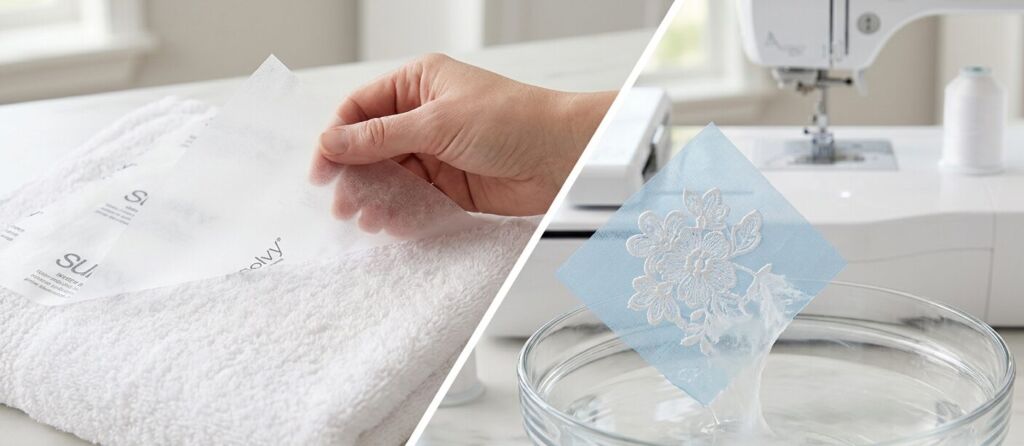
The 4 Types of Wash-Away Stabilizers
Not every wash-away stabilizer does the same job. Choosing the wrong type is one of the biggest reasons digitizers and stitchers run into puckering, sink-in, or designs that fall apart. Here’s how the four main categories break down.
1. Lightweight Topping Film
This is the thin, almost cellophane-like film you place on top of your fabric, not in the hoop as a backing. It’s the go-to choice for fabrics with a nap or pile, where stitches can sink in and disappear into the fibers. Products like Sulky Solvy and Sulky Ultra Solvy (often searched as “ultra solvy water soluble stabilizer”) fall into this group, along with lighter-weight options from the Floriani Wet n Gone line and the Madeira Avalon film. A light misting of water and it’s gone in seconds. For a closer look at how topping is used across different fabric types, see our guide to stabilizer topping.
2. Heavyweight Film
When a project needs to hold its own shape — with no fabric underneath at all, heavyweight film is the answer. This is the backbone of Freestanding Lace (FSL). Brands like Sulky Super Solvy, Sulky Ultra Solvy in its heavier form, Madeira Avalon Plus, and heavy-duty options sometimes labeled “fibrous water soluble stabilizer” are built for this. Stitchers often hoop two or three layers together to give dense FSL designs enough structure to survive the stitching process before the whole thing dissolves away.
3. Fabric and Mesh Wash-Away
This category has more of a true fabric-like hand and drape compared to plastic-feeling films. OESD Aquamesh (also searched as “aqua mesh wash away stabilizer”) is the best-known name here, prized for FSL pieces that need to drape softly (think doilies, lace edging, and ornaments). It’s also a common choice for badge and emblem work alongside dedicated products like OESD Badgemaster, which is built specifically for the structure badges and patches need before the final wash. If you need a similar mesh-like feel that stays in the garment permanently rather than washing out, our no-show mesh stabilizer guide covers that alternative.
4. Sticky and Printable Wash-Away
Sticky wash-away stabilizers solve one of embroidery’s most annoying problems: hooping items that don’t fit in a hoop at all. Sulky Sticky Fabri Solvy and the printable version, Sulky Printable Sticky Fabri Solvy, along with Pellon Stick n Washaway (commonly known as Pellon 542) and Floriani Wet n Gone Tacky, all use a paper-backed adhesive layer. Hoop the stabilizer sticky-side up, peel the paper liner, and press your fabric (collars, socks, pocket fronts, sleeves) directly onto it. Printable versions let you print a placement guide straight onto the stabilizer before you stitch. These work on the same hoop-it-first principle as our adhesive sticky-back stabilizers, with the added benefit that this version washes away completely afterward.
Wash-Away Stabilizer Comparison Chart
| Stabilizer Type | Best Used For | Popular Brands |
|---|---|---|
| Lightweight Topping Film | Towels, fleece, terry cloth, and other napped or pile fabrics where stitches sink in | Sulky Solvy, Sulky Ultra Solvy, Floriani Wet n Gone, Madeira Avalon |
| Heavyweight Film | Freestanding Lace (FSL), dense thread-only designs | Sulky Super Solvy, Sulky Ultra Solvy, Madeira Avalon Plus |
| Fabric/Mesh Wash-Away | Draped FSL (doilies, ornaments, lace edging), badges and patches | OESD Aquamesh, OESD Badgemaster |
| Sticky/Printable Wash-Away | Hard-to-hoop items: socks, collars, sleeves, pocket fronts | Sulky Sticky Fabri Solvy, Pellon Stick n Washaway, Floriani Wet n Gone Tacky |
When Should You Use Wash-Away Stabilizer?
Wash-away stabilizer earns its place in your kit any time a permanent backing would show through or change the feel of the finished piece. Sheer fabrics like organza, chiffon, and lace are the clearest example: a cutaway or tearaway backing would create a visible shadow or stiff patch behind delicate fabric, while a water-soluble option rinses away and leaves the fabric exactly as it was. Towels and terry cloth need a lightweight topping film on the front of the design so stitches don’t sink into the loops and disappear. Velvet and other plush fabrics benefit the same way: a topping prevents the pile from crushing and swallowing fine detail. And of course, Freestanding Lace relies entirely on heavyweight film or mesh wash-away as its only “fabric,” since the stitching itself becomes the finished piece once the stabilizer is gone.
How to Remove Wash-Away Stabilizer
Removing wash-away stabilizer properly is the difference between a soft, finished piece and one that feels stiff or “crunchy” for weeks afterward.
- Trim away the excess stabilizer close to the stitching before washing, since less material means a faster, cleaner dissolve.
- For lightweight topping film, a light mist of water is usually enough. Spray it directly, let it sit a few seconds, and gently rub. It will dissolve almost instantly.
- For heavyweight film, mesh, or FSL projects, submerge the piece in warm (not hot) water and let it soak for several minutes, agitating gently to help the stabilizer fully release.
- Rinse thoroughly, more than once if needed, since any leftover stabilizer dries hard and stiff.
- Lay flat to dry rather than wringing, especially for lace or delicate fabrics.
A common shortcut, wiping with just a damp sponge, only removes what’s on the surface. For anything heavier than a topping film, a full soak is the only way to dissolve what’s trapped between and underneath the stitches.
Common Mistakes
One of the most common mistakes is treating a quick wipe with a damp sponge as a substitute for a full soak. This leaves dissolved stabilizer trapped inside the stitches, and the finished piece ends up feeling crunchy or stiff once it dries. Another frequent error is confusing a lightweight topping film, which sits on top of the fabric during stitching, with a heavyweight structural backing meant to be hooped underneath, and using the wrong one can cause stitches to sink into the fabric or leave a Freestanding Lace design without enough body to hold its shape. Many embroiderers also store their wash-away stabilizer in humid spots like a garage or laundry room, where it absorbs moisture from the air and becomes sticky, wavy, or partially dissolved before it's even used. Finally, some stitchers skip a quick test on dense designs, not realizing that sticky or printable wash-away stabilizers can cause tunneling or puckering if hoop tension isn't adjusted first.
Frequently Asked Questions
What's the difference between wash-away, water-soluble, and dissolvable stabilizer?
What is sticky Fabri-Solvy and how do I use it?
Can I use wash-away stabilizer for Freestanding Lace (FSL)?
What's the best way to remove water-soluble stabilizer completely?
How should I store wash-away stabilizer so it doesn't go bad?
As an Amazon Associate and affiliate partner, we may earn a small commission from qualifying purchases at no extra cost to you.
Digitizer's Insight
Even the right stabilizer cannot fix a poorly digitized file. If you're still experiencing puckering, gaps, or registration issues after using the correct backing, the root cause is almost certainly your DST/EMB file — not your setup. Our team at EZ Stitch Digitizing specialises in precision pull-compensation and density correction.
Get Professional Digitizing →